
-
![website reviews]() 23 Jun 2026
23 Jun 2026 -
![google]()
I was lucky to have found Simon Security Systems online, Jose is extremely knowledgeable and resolved all issues that I was having. Jose is responsive and is someone that you can count on.
20 May 2026 -
![google]()
Jose was absolutely wonderful. He walked us through all our options at the consultation and helped us pick what best suited our needs/budget. He installed everything flawlessly and provided support afterwards (on how to use the equipment, change various settings, etc.) He and his team were remarkably responsive, efficient, and friendly and the equipment Jose suggested was perfect for what we were looking for. I’d recommend him without any hesitation!
29 Dec 2025 -
![google]()
Terrific experience. We are first time homebuyers and Jose made everything extremely easy for us. We got everything we were looking for and the turnaround time was very quick. Strongly recommend!!
15 Oct 2025 -
![google]()
Jose was very thorough, answered all our questions and worked efficiently. He did a great job and we are very happy with our system!
30 Jun 2025 -
![google]()
I had an absolutely professional and pleasant experience. Would highly recommend.
16 Jun 2025 -
![google]()
Jose from Simon Security quickly diagnosed and fixed all issues I was having. Extremely friendly and professional. Found this company because of the Google reviews so figured I would have to write one to say I agree with the what everyone has already said.
21 Apr 2025 -
![google]()
If you are in the market for a security system that is really, great image quality, phone apps and dependable Simon Security is one of the best system available
30 Mar 2025 -
![google]()
It was an absolute pleasure working with Simon Security! They were fast, very communicative, and offered relatively superior security technology vs. other local competitors in the area. Jose, whom I believe is the owner, was fantastic. I’d certainly work with them again.
10 Aug 2024 -
![google]()
Used Jose from Simon Security to install a new updated video system. So important to have an overall plan to keep our customers and families safe. Did a professional job with the “human” touch that went a long way.
20 Jun 2024 -
![google]()
Simply the best!!
11 Jun 2024 -
![google]()
This company has amazing pricing and expert installation. And customer service that is exceptional.
11 Jun 2024 -
![google]()
Outstanding Service
11 Jun 2024 -
![google]()
Couldn’t be any more happier with Simon Security. They are professionals through and through and the peace of mind the cameras bring to the home is priceless. Highly recommended.
16 Sep 2023 -
![google]()
Short version, original installer of the security system was paid in full. I was playing text and phone tag with original installer. I needed him to reset the system for a new manager. I wasted more time moving my schedule around to fit the original flake of an installer. I gave up and called Simon Security. The problem was fixed and I went on with my life.
14 Jul 2021 -
![google]()
We hired Simon Security for both an upgrade and to add new equipment to an old system for our senior facility.. Jose was friendly, informative and very fair with pricing. He completed the job very quickly and was very neat, leaving a clean professional looking job when he was done. He was never too busy to talk about what we were doing and made several return trips to help us with follow up questions. We will definitely use him again as we continue to upgrade and add new equipment to our system. Thanks for a great job Jose, I’ll be sure to recommend you anytime I can!👍🙏
26 Feb 2021 -
![google]() 23 Feb 2021
23 Feb 2021 -
![google]() 23 Feb 2021
23 Feb 2021 -
![google]()
Worked directly with Jose Q. He offered exceptional, personalized service and that's what he provided. Made us comfortable with his explanation's of the equiptment and services he proposed then delivered exactly what we needed on time and at a reasonable cost. He has provided us with far ranging WIFI, camera systems and alarm systems. Very comfortable recommending Simon Security Systems.
09 Feb 2021 -
![google]()
We hired Simon Security to install cameras on our residential home, and they were very professional, prompt and efficient. I would highly recommend to anyone for their security needs.
24 Oct 2020 -
![google]() 25 Jun 2020
25 Jun 2020 -
![google]()
Very professional staff with all the cutting edge technology. This company was able to recommend some innovative products and put some concerns I had about my security to rest . I highly recommend Simon for my home and my business security needs.
24 Jun 2020 -
![google]()
We hired Simon Security Systems for several projects, and they delivered value, prompt service and reliable.
20 Jun 2020 -
![google]()
We could not be happier with the quality of work and customer service!
17 Jun 2020 -
![google]() 15 Jun 2020
15 Jun 2020 -
![google]()
Great experience, fast reliable and pleasant to work with. Will be using them again.
13 Jun 2020


Commercial Fire Alarm System Design & Life Safety Integration
Protecting lives, securing assets, and ensuring total code compliance. Simon Security Systems provides expert commercial fire alarm systems installation for complex corporate, industrial, and institutional environments.
Commercial Fire Alarm System Installation for New York Businesses
Simon Security Systems provides reliable commercial fire alarm system installation designed to help businesses detect fire hazards quickly and protect people, property, and critical assets. Our team delivers professionally engineered and configured systems tailored to the strict compliance requirements of offices, retail properties, industrial facilities, and commercial buildings across New York City, Westchester, Long Island, and surrounding areas.
Professional Commercial Fire Alarm Installation & Monitoring
From custom system design and equipment selection to installation, testing, and ongoing support, Simon Security Systems helps businesses maintain dependable, NFPA-compliant life safety systems. To ensure complete facility protection around the clock, our commercial fire alarm monitoring solutions provide continuous 24/7 oversight—enabling rapid verification and priority dispatch to local first responders the moment an event occurs.
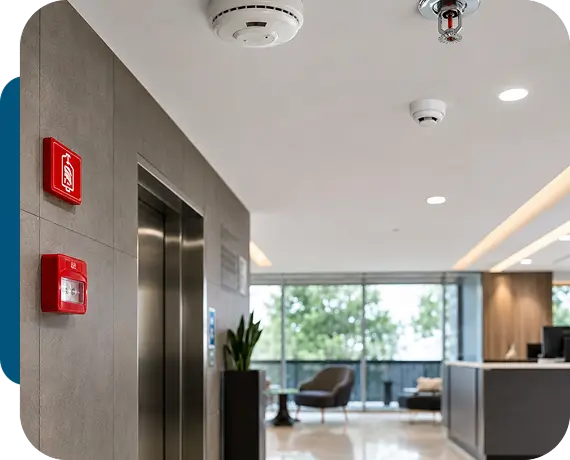
Professional Commercial Fire Alarm Services
Fire and life safety systems are the most critical components of your building’s infrastructure. At Simon Security Systems, we provide a full lifecycle of support from initial engineering to 24/7 monitoring. Our team ensures your facility meets all NFPA standards and local New York fire codes, providing peace of mind for owners and occupants alike.
Service Capabilities:
Turnkey Safety and Security Solutions
Navigating fire codes and city permits can be a logistical challenge. Simon Security Systems simplifies the process by providing turnkey safety and security solutions. We manage every phase of your project, serving as your single point of accountability from blueprinting to final sign-off.

What Our Turnkey Approach Includes:
- Permit & Plan Management: We handle all filings and liaison with local fire departments across New York.
- Seamless Integration: Our fire systems integrate with your Access Control to automatically release electromagnetic locks, ensuring safe and unhindered egress during an alarm.
- System Scalability: From high-rise commercial real estate to expansive industrial warehouses, our systems are engineered to scale with your footprint.
Expert Engineering for Specialized Industries
Our NICET-certified professionals provide the technical depth required to design, install, and maintain fire systems for complex commercial environments. From healthcare facilities to corporate headquarters, Simon Security Systems ensures total code compliance and operational continuity through every stage of your system’s lifecycle.
Certified Lifecycle Stewardship
Our turnkey commitment extends beyond installation. Every system is supported by NICET-certified and factory-trained technicians. We provide a complete lifecycle of Commercial Fire Alarm Services, including:
Precision Testing &
Inspections
Ensuring your infrastructure meets all NFPA mandates.
Fire Sprinkler System Coordination
Integrating automatic suppression as an essential component of your fire protection strategy.
Maintenance & Rapid
Repair
Minimizing system downtime through proactive local support.
The Advantages of an Integrated Commercial Fire Alarm System
A professionally installed fire system is more than a legal requirement—it is a strategic investment in business continuity and risk management.

Key Benefits:
- Total Code Compliance: Avoid costly fines, "Failure to Comply" notices, and potential facility shutdowns by staying ahead of local fire ordinances.
- Asset & Property Preservation: Early-stage detection allows for faster suppression, significantly reducing structural damage and data loss.
- Insurance Premium Optimization: Most commercial insurance providers offer reduced premiums for facilities protected by professionally monitored fire alarm systems for commercial buildings.
- Enhanced Liability Protection: Documented inspection logs and professional maintenance protect your organization from negligence claims.

Why Choose Simon Security Systems?
We provide more than just hardware. Simon Security Systems delivers a strategic partnership built on technical excellence and local accountability to ensure your facility remains secure 24/7.
Our Pillars:
- Certified Expertise: Licensed and manufacturer-certified technicians who understand the specific rigors of New York fire codes.
- System Stewardship: We don’t just install; we maintain and monitor your system for its entire lifecycle.
- Local Accountability: Regional coverage across New York with rapid on-site response for life safety systems.
Unified Enterprise Security Solutions for Businesses Across New York
At Simon Security Systems, we deliver a fully integrated suite of security solutions designed to protect every layer of your organization. Our services include commercial fire alarm systems, security video monitoring, visitor management, system maintenance, video surveillance, access control, and intrusion detection. By unifying all security functions under one trusted provider, we ensure a seamless, scalable, and fully optimized infrastructure that supports long-term safety, compliance, and operational continuity.
Explore our Integrated Solutions
Fire Safety, Video Monitoring , Visitor Management, System Maintenance, Video Surveillance, Access Control, Intrusion Detection
FAQs
-
Are your fire alarm installations NYC code compliant?
Yes. All our commercial fire alarm systems are designed and installed to meet strict NYC DOB and NFPA 72 requirements, ensuring your facility is fully compliant and safe.
- Do you provide 24/7 professional fire alarm monitoring?
- How often should a commercial fire alarm system be tested?
Trusted Security Solutions Backed by Real Customer Experiences
Homeowners and businesses trust Simon Security Systems for dependable protection, professional installations, and responsive service. Read what our customers have to say about working with our team.


Commercial Fire Alarm Systems Installation for Safer Facilities
Don't risk the safety of your occupants or the compliance of your operations. Simon Security Systems provides professional commercial fire alarm systems designed to help protect your facility and support reliable fire detection.
Jose is top notch! He works so hard, answers our calls and texts and helps explain it all. He suggests items we didn’t even think about and discussed items insurance broker’s suggests as well. He’s well versed, patience and gets the job done. Super detail oriented! Cannot recommend him enough!